

Running a pharmacy in Vancouver, whether it’s an independent dispensary on Granville Street or a compounding pharmacy in West Vancouver, means handling some of the most sensitive personal information that exists. Every day, prescriptions are filled, patient profiles are updated, insurance claims are processed, and medical histories are referenced. Honestly, that’s an enormous amount of documentation and pharmacy document shredding in Vancouver is the one step that determines whether it’s disposed of safely or not.
Why Pharmacies Handle Some of the Most Sensitive Documents in Canada
Think about what passes through a pharmacy counter in a single week. Prescription labels bearing a patient’s full name, home address, date of birth, and medication. Insurance forms packed with policy numbers and benefit details. Physician fax notes. Controlled substance logs. Patient counselling records. Return-to-stock paperwork.
Really, when you stack it all up, pharmacies are sitting on a goldmine of personally identifiable information and unfortunately, that makes them a target. Identity thieves and opportunistic fraudsters know that health records contain richer data than almost any other document type. A single discarded prescription label found blowing across a parking lot can expose a patient’s name, birthday, address, and medical condition all at once. That’s more than enough to cause genuine harm.
This is precisely why PHI disposal isn’t just a compliance box to tick. It’s a responsibility that deserves the same attention as dispensing the correct medication to the correct patient, and that’s saying something.
Understanding PHI: What Exactly Is at Risk?
Protected Health Information, or PHI, refers to any information that can identify an individual and is tied to their health status, healthcare provision, or payment for those services. In the context of a Canadian pharmacy, this spans a surprisingly wide range of document types that accumulate fast.
Common PHI Documents Found in a Pharmacy Setting
- Prescription order forms, both printed and handwritten, are physician orders
- Patient profile printouts generated by dispensing software systems
- Insurance claim forms and explanation of benefits (EOB) documents
- Physician referrals and clinical notes received by fax
- Medication administration records (MARs) in long-term care or assisted living contexts
- Controlled drug registers, especially for substances like codeine, methadone, or benzodiazepines
- Return-to-stock and unclaimed medication records
- Patient complaint forms or incident reports that reference identifiable individuals
That last category tends to surprise people. Even internal documents that reference a patient in any context can qualify as PHI and must be treated accordingly during disposal. This is one area where a lot of pharmacies unknowingly fall short.
The Hidden Danger of Improper PHI Disposal
Here’s a scenario worth pausing on. Imagine a small independent pharmacy in West Vancouver doing a year-end filing cabinet cleanout. An overwhelmed staff member tosses a garbage bag of old patient records into the blue bin because the office shredder is jammed, and it seems faster to get it done. A few days later, that bag tears open at the curb, and someone walking by picks up a handful of prescription records.
That scenario isn’t hypothetical. Variations of it happen across Canada every year. And when it does, the consequences for the pharmacy and the patients exposed can be severe and long-lasting.
Legal Obligations for Pharmacies in British Columbia
Let’s be real: compliance isn’t optional, and it’s not something you can quietly ignore until a problem surfaces. Pharmacies operating in BC are governed by a layered framework of privacy legislation that dictates exactly how personal health information must be collected, stored, used, and, critically, destroyed.
PIPEDA and BC’s PIPA
At the federal level, the Personal Information Protection and Electronic Documents Act (PIPEDA) establishes baseline standards for how private sector organizations handle personal data. British Columbia’s own Personal Information Protection Act (PIPA) complements this at the provincial level, applying directly to most community pharmacies operating in the province.
Both pieces of legislation are explicit: when personal information is no longer needed for its original purpose, it must be destroyed in a manner that prevents unauthorized access or recovery. That’s not a guideline or a best practice. It’s a legal requirement.
What Happens If You Fall Short?
Non-compliance isn’t just an abstract risk. The Office of the Information and Privacy Commissioner for BC (OIPC) actively investigates complaints, conducts audits, and can order organizations to take corrective action. In more serious cases, the reputational damage alone can be devastating for a small pharmacy that relies on community trust.
Beyond the OIPC, pharmacies in BC are also accountable to the College of Pharmacists of BC, which holds its own professional standards around patient confidentiality and record management. A documented breach can trigger a professional conduct review, something no pharmacist wants hanging over their practice.
Why a Shredder in the Back Room Just Isn’t Enough
Honestly, a lot of smaller pharmacies think they’ve got this handled because there’s a strip-cut shredder sitting in the corner of the stockroom or beside the dispensary counter. And, understandably, it feels like the right call. It’s visible, it’s there, and staff can use it when they remember. But there are real and serious limitations to this approach.
Strip-cut shredders don’t deliver the level of security that PHI destruction actually demands. The long strips they produce can be painstakingly reassembled by someone determined enough. Industry standards, including those set by organizations like NAID (the National Association for Information Destruction), recommend cross-cut or micro-cut shredding for sensitive documents, reducing paper to small confetti-like particles that are essentially impossible to reconstruct in any meaningful way.
There’s also the chain of custody problem that in-house shredding can’t solve. When individual staff members shred documents on the fly, there’s no audit trail. No record of what was destroyed, when it was destroyed, or by whom. And if your pharmacy is ever audited, investigated, or named in a complaint, that documentation gap can become a significant liability all on its own.
Professional pharmacy document shredding in Vancouver services address both of these issues systematically.
What to Look for in a Pharmacy Document Shredding Service
Not all shredding providers are created equal, and when PHI is involved, the difference matters enormously. Here’s what a pharmacy should be looking for when evaluating a shredding partner:
- NAID AAA Certification: This is the gold standard in the data destruction industry. It signals the provider has undergone rigorous third-party auditing of their security protocols, employee background screening, and equipment standards. Don’t skip this requirement.
- Locked, tamper-proof consoles are placed on-site so that documents are secured from the moment they leave the dispensary counter.
- Clear chain of custody documentation at every stage of the process
- A Certificate of Destruction is issued after every service pickup.
- Flexible scheduling options, including monthly, biweekly, weekly, or one-time purge services, as your volume demands require
Certificate of Destruction: Why It Matters More Than You Think
Every time a professional shredding company destroys your documents, they should issue a Certificate of Destruction. This isn’t a formality, it’s your documented proof that PHI was disposed of properly, on a specific date, by a certified provider. For pharmacies, this certificate is the paper trail you lean on if your disposal practices are ever called into question.
Keep these on file alongside your other compliance records. They’re the backbone of your data disposal audit trail.
On-Site vs. Off-Site Shredding: Which Makes More Sense for Pharmacies?
Great question, and the right answer depends on your pharmacy’s specific setup and comfort level.
On-site (mobile) shredding brings an industrial shredding truck directly to your pharmacy location. Documents are destroyed right there, in front of your staff, which some pharmacies prefer because it provides immediate, visual confirmation that records have been eliminated. It works particularly well for large one-time purges when you’re clearing out years of archived files, for example, or moving to a new location.
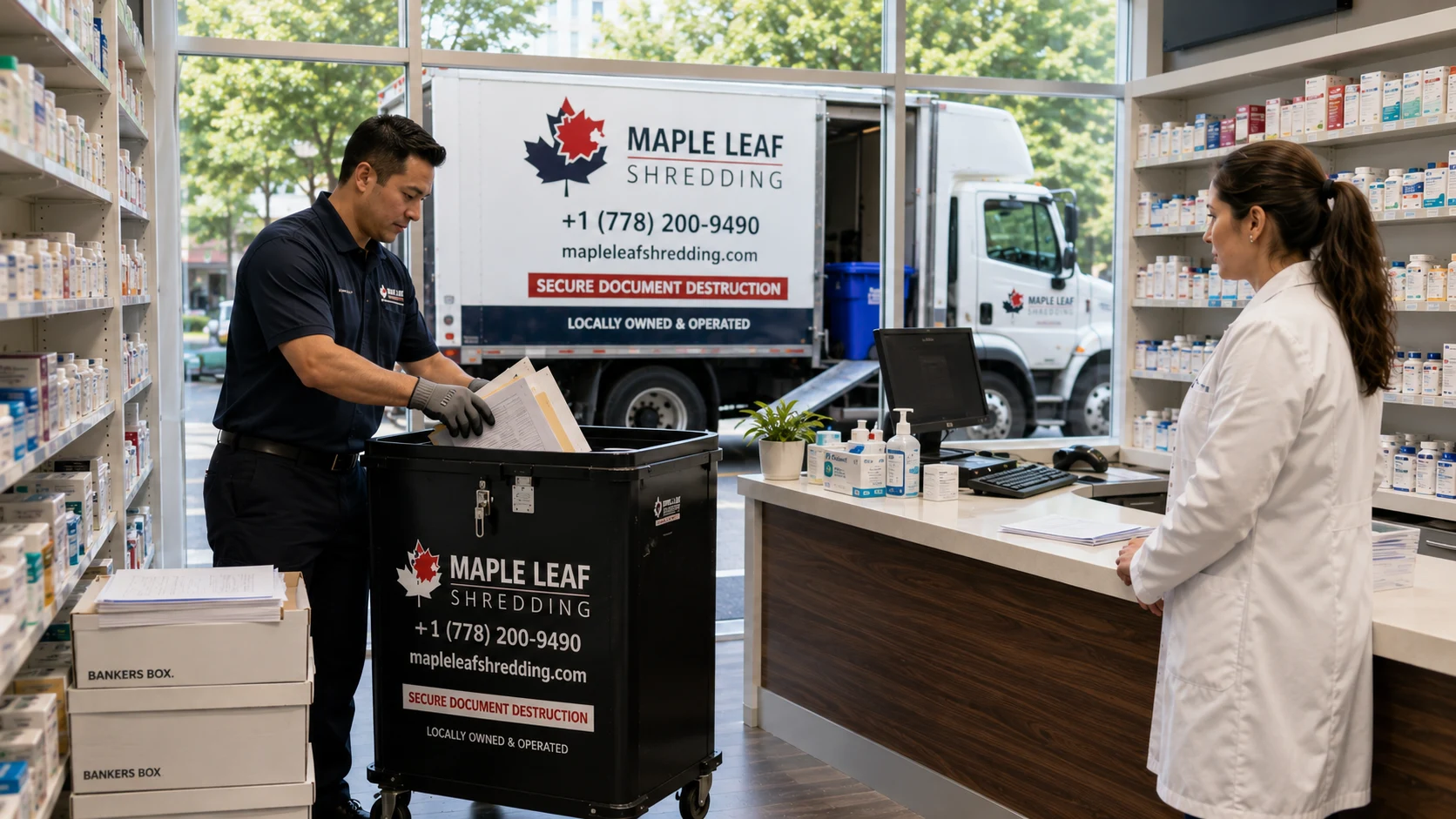
Off-site shredding involves locked collection consoles being serviced on a schedule. A technician picks up the sealed containers and transports them to a secure facility where destruction occurs under strict protocols. This method tends to be more cost-effective for ongoing scheduled services and is equally secure when the provider is properly certified.
For the majority of pharmacy document shredding in Vancouver scenarios, a scheduled off-site shredding service with locked on-site consoles is the practical sweet spot. You set it up once, and it gets handled on autopilot.
How Maple Leaf Shredding Supports Vancouver and West Vancouver Pharmacies
If you’ve been searching for reliable shredding near me, Maple Leaf Shredding has been a trusted partner for businesses across Vancouver and West Vancouver, including healthcare-adjacent organizations that hold sensitive personal data. They understand that pharmacies aren’t general offices; they’re regulated, privacy-sensitive environments where documentation standards are high, and the stakes around disposal are even higher.
What stands out about Maple Leaf Shredding is its commitment to compliance-driven service delivery. They don’t just shred paper and move on; they provide the documentation, certifications, and scheduling consistency that pharmacies need to stay firmly on the right side of PIPA, PIPEDA, and College of Pharmacists standards.
Whether you need secure shredding services near me for a one-time document purge or want to establish a regular pickup cadence, Maple Leaf Shredding offers flexible service plans that scale appropriately to your pharmacy’s volume and workflow.
The Shredding Process: A Step-by-Step Look
Wondering what the actual workflow looks like once you’ve partnered with a professional shredding provider? Here’s how a typical engagement unfolds for a Vancouver-area pharmacy:
- Initial consultation: The provider assesses your document volume, storage setup, and compliance needs.
- Console placement: Locked, tamper-proof collection consoles are placed in accessible but secure areas of your pharmacy.
- Ongoing document deposit: Staff drop documents into the console throughout the service period. No sorting, no separation required.
- Scheduled pickup: A certified technician arrives on your agreed schedule to collect the sealed console contents.
- Secure destruction: Documents are shredded using industrial-grade cross-cut or micro-cut equipment.
- Certificate of Destruction issued. You receive formal documentation confirming what was destroyed and when.
That’s what professional document shredding in Vancouver should look like: streamlined, fully documented, and completely off your plate.
How Often Should Your Pharmacy Be Shredding?
There’s no universal answer, but it’s worth thinking through based on your actual document volume. A high-traffic retail pharmacy filling hundreds of prescriptions a day generates significantly more PHI paperwork than a small specialty dispensary seeing 40 patients a week. Here’s a rough framework:
- High-volume retail pharmacies: weekly or biweekly service
- Mid-size independent pharmacies: monthly service
- Smaller dispensaries or specialty pharmacies: bimonthly or quarterly, with provisions for ad hoc purges when volume spikes
The key principle is simple: PHI documents should never accumulate longer than necessary. The longer they sit in a filing cabinet, a cardboard box under the counter, or a recycling bag in the storage room, the greater the exposure risk for your patients and your practice.
And don’t overlook digital media. Hard drives, USB keys, CDs, and other storage devices that hold patient records also require proper destruction. Many providers offering paper shredding in Vancouver extend their services to include certified media destruction, which is also worth asking about when you set up your service.
Conclusion
Pharmacy document shredding in Vancouver is far more than an administrative afterthought; it’s a cornerstone of responsible, compliant pharmacy practice. Whether you operate a long-established pharmacy in West Vancouver or a newer independent dispensary in the heart of downtown, the obligation to protect your patients’ PHI doesn’t end when the file is closed or the prescription is filled. It extends all the way to the permanent, irreversible destruction of every record that carries their personal information.
Investing in professional, certified secure document shredding is one of the smartest operational decisions a pharmacy owner or manager can make. It protects patients, shields the business from regulatory exposure, satisfies the requirements of PIPA and PIPEDA, and cultivates a culture of privacy that your staff and your community will genuinely notice. Don’t let old prescriptions, insurance forms, or controlled substance logs become a liability sitting in a filing drawer. Take the right steps today and make sure PHI disposal is handled by professionals who know exactly what’s at stake.
Ready to Protect Your Patients’ PHI?
Maple Leaf Shredding is Vancouver’s trusted partner for secure, certified pharmacy document destruction. Whether you need a recurring shredding schedule tailored to your dispensary’s volume or a one-time purge to clear out years of accumulated records, the team at Maple Leaf Shredding is ready to help you get compliant and stay there.
Find Maple Leaf Shredding on Google Maps and see why pharmacies across Vancouver and West Vancouver rely on them for secure, documented, and hassle-free PHI disposal every single time.