
Picture this: it’s a rainy Tuesday in West Vancouver, and a box of old client files is sitting in your storage room. It’s been there for years. Nobody’s touched it. Nobody’s thought about it. Then one day, somebody does, and it’s not somebody you’d want anywhere near your clients’ personal information.
Honestly, that scenario plays out more often than most business owners would like to admit. Tossing sensitive documents into a recycling bin or dragging a hard drive to the curb might feel like housekeeping, but in reality, it’s a legal and reputational gamble. That’s exactly why a Certificate of Destruction in Vancouver has become one of the most important pieces of paper (ironically) that your business can hold onto.
In this guide, we’ll break down what a certificate of destruction actually is, why it matters so much for businesses across Vancouver and the North Shore, and how to make sure you’re getting one every single time you destroy sensitive material.
What Exactly Is a Certificate of Destruction?
Let’s start with the basics. A certificate of destruction is a formal, legally recognized document issued by a professional shredding or destruction company after they’ve securely destroyed your materials. Think of it as a receipt, but instead of proving you bought something, it proves you destroyed something properly.
When you work with a professional provider of document shredding in Vancouver, the certificate confirms that your paper records, hard drives, or other media were destroyed in accordance with recognized industry standards and that a documented chain of custody was maintained from pickup to final destruction.
What’s Actually Included on the Certificate
A proper certificate isn’t just a fancy letterhead with the word “destroyed” stamped on it. A legitimate Certificate of Destruction in Vancouver should typically include:
- The date and location of the destruction
- A description of the materials destroyed (paper documents, hard drives, media, etc.)
- The method of destruction used (cross-cut shredding, physical hard drive destruction, and so on)
- A unique transaction or serial number for audit purposes
- The name of the witnessing or supervising technician
- Confirmation of the chain of custody from collection to destruction
If a provider hands you something vague and missing half of these details, that’s a red flag. Really, it is. The whole point is verifiable proof, and vague paperwork doesn’t hold up when a regulator or auditor comes knocking.

Why Vancouver Businesses Can’t Afford to Skip This Step
Here’s the thing: destroying documents and getting proof that you destroyed documents are two completely different things in the eyes of the law. You can shred every scrap of paper in your office, but if you can’t demonstrate it, you’re still exposed.
PIPEDA and BC’s PIPA: The Legal Side of Things
In Canada, the Personal Information Protection and Electronic Documents Act (PIPEDA) governs how private-sector organizations handle personal information. Here in British Columbia, we also have our own provincial law, the Personal Information Protection Act (PIPA), which applies to most private organizations operating in the province.
Both pieces of legislation share a common thread: businesses are responsible for safeguarding personal information throughout its entire lifecycle, and that includes its disposal. When personal data is no longer needed, it must be destroyed in a way that prevents unauthorized access. Simply put, the law doesn’t just care that you got rid of records; it cares how you got rid of them.
A Certificate of Destruction in Vancouver gives you documented evidence that you met that obligation. If your business is ever audited, investigated, or challenged after a privacy complaint, that certificate can be the difference between a quick resolution and a very expensive headache.
The Real Cost of Getting It Wrong
Let’s be real for a moment, data breaches aren’t just an “IT problem” anymore. They’re a business survival problem. Depending on the severity, a privacy breach in Canada can lead to:
- Regulatory investigations and fines
- Civil lawsuits from affected clients or employees
- Mandatory breach notifications, which are embarrassing and costly
- Lost customers who don’t trust you anymore
And here’s the part that stings: many breaches don’t come from sophisticated hackers in dark hoodies. They come from a filing box left in an alley, an old office computer donated with the hard drive still inside, or a dumpster that somebody decided to dig through. Physical disposal failures are shockingly common, and they’re almost entirely preventable.
Who Needs a Certificate of Destruction? (Spoiler: Probably You)
You might be thinking, “Sure, but my business is small. Does this really apply to me?” Short answer: yes. If you collect names, addresses, financial details, health records, or employee information, and honestly, what business doesn’t? You have a duty to dispose of it securely.
Medical, Dental, and Wellness Clinics
Healthcare providers handle some of the most sensitive information out there. Patient charts, lab results, and insurance details demand airtight disposal practices. Clinics across Vancouver and West Vancouver routinely rely on secure shredding services near me searches to find certified providers, because a single mishandled patient file can trigger serious professional and legal consequences.
Law Firms and Accounting Offices
Client confidentiality isn’t a nice-to-have in the legal and financial world; it’s the foundation of the entire relationship. Law societies and professional accounting bodies expect firms to maintain strict document controls right up to (and including) destruction. A certificate provides the audit trail on which these professions are practically built.
Real Estate, Retail, and Everyone Else
Real estate offices hold mortgage applications and ID copies. Retailers keep employee records and old payment paperwork. Property managers store tenant applications packed with personal details. Even a small landscaping company has payroll records and banking information sitting in a drawer somewhere. If it identifies a person, it needs secure destruction, full stop.
Paper Isn’t the Only Risk: Hard Drives and Digital Media
Now, here’s where a lot of businesses drop the ball. They’re diligent about paper, but old computers, laptops, and external drives pile up in a closet like some tech graveyard. Sound familiar?
Why Deleting Files Isn’t Actually Enough
Hitting “delete” doesn’t erase data. Neither does emptying the recycle bin, and honestly, even reformatting a drive often leaves data recoverable with widely available software. Anyone with modest technical skills and questionable ethics can pull tax records, client databases, and saved passwords off a drive you thought was wiped clean.
That’s why more Vancouver businesses are searching for HDD Destruction Services in Vancouver rather than trying to handle it themselves. Professional destruction physically obliterates the drive platters, making data recovery genuinely impossible, not just inconvenient.
The Right Way to Destroy a Hard Drive
Professional destruction typically involves physically crushing, shredding, or punching the drive so the platters that store your data are destroyed beyond any hope of reconstruction. Afterwards, you receive a certificate listing the serial numbers of the destroyed drives. That serial-number tracking is gold during an audit, you can prove that specific device, the one that held your client database, no longer exists in any usable form. If you’ve been putting off dealing with that closet full of old tech, a quick search for HDD Destruction Services near me is a solid first step.
How the Certified Destruction Process Actually Works
Wondering what this looks like in practice? It’s simpler than most people expect, and that’s the point: security shouldn’t be complicated for the client.
Step by Step, From Pickup to Certificate
- Collection or drop-off. Your materials are gathered from locked consoles at your office, picked up as a one-time purge, or dropped off at the provider’s facility.
- Chain of custody begins. From the moment the materials leave your hands, they’re tracked. Screened, bonded personnel handle everything.
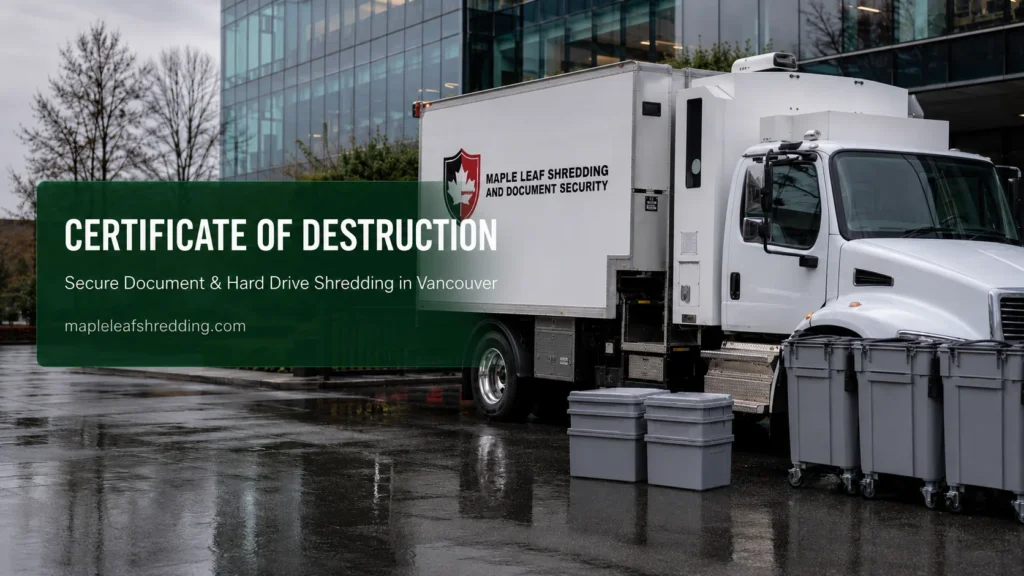
- Secure destruction. Documents are shredded using industrial cross-cut equipment; hard drives are physically destroyed. This can happen on-site in a mobile shred truck (so you can literally watch it happen) or at a secure facility.
- Recycling. Shredded paper is baled and recycled, a nice bonus for businesses tracking their environmental footprint. Vancouver companies love this part, and fair enough.
- Certificate issued. You receive your Certificate of Destruction in Vancouver, which goes straight into your compliance records.
The whole process, from a business owner’s perspective, takes minutes of your time. Compare that to the weeks (or months) of damage control after a breach, and it’s not really a debate, is it?
On-Site vs. Off-Site Shredding in West Vancouver
Businesses in West Vancouver and across the Lower Mainland generally choose between two service models, and both come with certification.
On-site shredding means a truck arrives at your location and destroys your material right there in the parking lot. You can witness the destruction with your own eyes, which some industries and some very cautious office managers strongly prefer.
Off-site shredding means your materials are collected in locked containers and transported under strict chain of custody to a secure facility for destruction. It’s often more economical for large volumes, and the security controls are just as rigorous.
Which is better? Honestly, it depends on your volume, your compliance requirements, and your comfort level. The key is that either way, your provider should hand you a certificate when the job’s done. No certificate, no deal.
What to Look for in a Shredding Partner
Not all providers are created equal, and choosing the right one matters as much as choosing to shred in the first place. When you’re comparing options for paper shredding in Vancouver businesses trust, keep an eye out for a few things: proper industry certification, screened and uniformed staff, locked collection containers, GPS-tracked vehicles, and, you guessed it, a certificate of destruction issued with every service.
Local knowledge counts too. A provider that actually operates in your community understands the rhythms of Vancouver businesses, from downtown offices to North Shore clinics, and can build a schedule around how quickly your paperwork actually piles up.
Questions Worth Asking Before You Sign
- Do you provide a certificate of destruction with every single service?
- Are your staff background-checked and bonded?
- Is your destruction process compliant with PIPEDA and BC’s PIPA?
- Do you offer both scheduled service and one-time purges?
- Can you destroy hard drives and electronic media, not just paper?
If a provider hesitates on any of these, keep looking. Seriously.
A Quick Story From the Field
A small accounting firm here in the Lower Mainland with three partners and a handful of staff once cleared out a decade of old client files during an office move. They hired a general junk removal company to haul it all away. Cheap, fast, done. Or so they thought.
Months later, a client called in a panic: their old tax documents had been found, intact, at a transfer station. The firm had no certificate, no chain of custody, no proof of anything. What followed was a privacy complaint, some very uncomfortable client conversations, and legal fees that dwarfed what professional destruction would have cost a hundred times over.
The lesson? Cheap disposal isn’t disposal. It’s just moving your risk somewhere you can’t see it. If they’d searched for shredding near me and hired a certified provider, the whole ordeal would never have happened.
Conclusion
At the end of the day, a Certificate of Destruction in Vancouver isn’t bureaucratic box-ticking; it’s tangible proof that your business takes privacy seriously, meets its legal obligations under PIPEDA and BC’s PIPA, and protects the people who trust you with their information. Whether you’re a medical clinic in West Vancouver, a law office downtown, or a growing small business with a storage room full of “we’ll deal with it later” boxes, certified destruction closes the loop on data security in a way that DIY shredding and delete keys never can. The cost is modest, the process is painless, and the peace of mind is, frankly, priceless. Don’t wait for a breach to teach you the lesson the hard way. Get ahead of it, and get it in writing.
Ready to Protect Your Business?
Don’t leave your company’s reputation sitting in an unlocked recycling bin. Maple Leaf Shredding provides secure, certified document and hard drive destruction for businesses across Vancouver, West Vancouver, and the North Shore with a Certificate of Destruction issued after every job. Visit mapleleafshredding.com to request your free quote today, or find Maple Leaf Shredding on Google Maps to see reviews from local businesses and get directions to book your pickup. Your clients trust you with their information; make sure that trust is deserved, right down to the last shredded page.