
Clearing out a filing cabinet raises one question: when does a document stop mattering? For tax records in Canada, the answer is six years from the end of the tax year they relate to. That rule covers tax returns, the slips and receipts behind them, and most business records.
This guide explains how the rule works, how long to keep documents of each type, and how to shred the ones that have reached the end of their life. It is general information, not tax or legal advice.
The Short Answer: The CRA Six-Year Rule
The CRA’s rule is short: generally, you must keep all required records and supporting documents for six years from the end of the last tax year they relate to. That answers the question of CRA how long to keep records, and it applies to paper and electronic records alike. The clock starts at the end of the tax year.
Late filing means six years from the filing date. An open objection or appeal means keeping the records until it settles. The CRA can also require a longer period, and that instruction overrides the usual one. A dissolved corporation’s records are kept two years after dissolution. Property and wind-up records must be kept indefinitely.
The CRA record keeping requirements also cover where records are kept. Keep them at your business or home in Canada, available to CRA officials when asked. Scanned copies can replace paper originals, but only when your imaging process meets the CRA’s electronic record-keeping conditions. Check images are readable first, and log what was imaged and when.
How Long to Keep Tax Records in Canada, Document by Document
The table below answers what documents to keep and for how long. It separates the CRA rule from general guidance. Where it says “CRA rule”, the period comes from the CRA. Where it says “general guidance”, the CRA rule still overrides it for tax-supporting documents.
| Document | Keep for | Basis |
|---|---|---|
| Tax returns and supporting documents | 6 years from end of tax year | CRA rule |
| T4, T5 and other slips; notice of assessment | 6 years from end of tax year | CRA rule |
| GST/HST records | 6 years from end of tax year | CRA rule |
| Business invoices, receipts and ledgers | 6 years from end of tax year | CRA rule |
| Payroll records that support tax filings | 6 years from end of tax year | CRA rule |
| Property purchase and sale records | Indefinitely — while you own it, and after sale | CRA rule: indefinite where they affect a sale |
| Bank statements | 1 year; 6 years if they support a tax or business claim | General guidance; CRA rule overrides |
| Pay stubs | Until checked against your T4, then 1 year | General guidance |
| Mortgage documents | While the mortgage is active, and after it ends | General guidance |
| Medical records and insurance claims | While treatment or coverage is relevant | General guidance: ask your provider |
Two details deserve attention. First, how long to keep tax returns in Canada is the same question as how long to keep the documents behind the return. The return is a summary; the slips and receipts are the evidence, so they share the six-year period.
Second, how long to keep business records in Canada follows the same rule: invoices, receipts and ledgers also get six years. Count from the end of the tax year, not from the date on a receipt. The same logic applies to how long to keep tax documents of any kind.
How Long to Keep Documents That Are Not Tax Records
Not every paper needs six years: if the CRA could ask for it, the six-year rule applies, whatever it is called.
Bank Statements, Pay Stubs and Everyday Receipts
Everyday banking guidance is shorter than the tax rule. How long to keep bank statements in Canada is commonly given as one year for ordinary personal statements. How long to keep pay stubs in Canada follows the same idea: keep them until checked against your T4, then about a year. How long to keep receipts in Canada is similar: keep a receipt while a return, warranty or purchase can still be questioned.
None of that is a CRA rule. If a bank statement or receipt supports a business expense, a rental claim or a donation on a tax return, it is a supporting document for that return, and the six-year period applies. Sort by use: tax papers in one folder for six years, everyday papers cleared once a year. When in doubt, keep it in the tax folder.
Employee and Payroll Records for Small Businesses
For a business with staff, the question splits in two. How long to keep employee records in Canada depends on which records you mean. Payroll records that support tax filings — pay registers, source-deduction records and the slips issued from them — follow the CRA six-year rule. Other records, such as applications and contracts, follow provincial employment and privacy rules.
In British Columbia, check the Employment Standards Act and any applicable privacy obligations before you set a destruction date for those files. Whatever periods you adopt, write them down and keep a destruction log: what was destroyed, which tax years or employees it covered, the date, and who approved it.
When Can You Shred Old Tax Returns?
You can shred old tax returns once the retention period has ended and nothing is still open. For most people that means six years from the end of the tax year, with nothing open and no CRA instruction to keep them longer. When to shred tax documents is a date you can work out in advance: take the tax year, add six years to the end of it, and put that date on the box.
If you want to destroy records before the period ends, you need written permission from the CRA first. Apply with Form T137, Request for Destruction of Records, or by letter to your tax services office, and wait for permission before you shred. When can I shred old tax returns has a second half, too: pull out anything with a longer life first, such as property, share and governing documents.
- Retention period ended — six years from the end of the tax year, or from filing if late.
- No objection or appeal is open, and the CRA has not asked you to keep the records longer.
- Property, share and governing documents have been removed and kept separately.
- Any scanned copies have been checked and are readable before the paper is destroyed.
- You have noted what was destroyed and when, for your own records.
How to Shred Expired Records Safely
Shredding is the last step, and it is worth doing properly. A document that has passed its retention date is still full of personal information until it is destroyed beyond recovery. Recycling leaves names, account numbers and tax details readable, and identity theft often starts with discarded paper. Start with the guide to what documents should you shred; the dates here are the “when” for that “what”.
A home shredder is fine for a handful of pages, but it struggles with the volume a real cleanout produces. Professional secure document shredding is built for that job: large volumes, staples and folders included, and a documented process. If you are searching for shredding near me, compare options on what they destroy, whether you can watch, and whether you get a written record.
On-Site Shredding for a Home or Office Cleanout
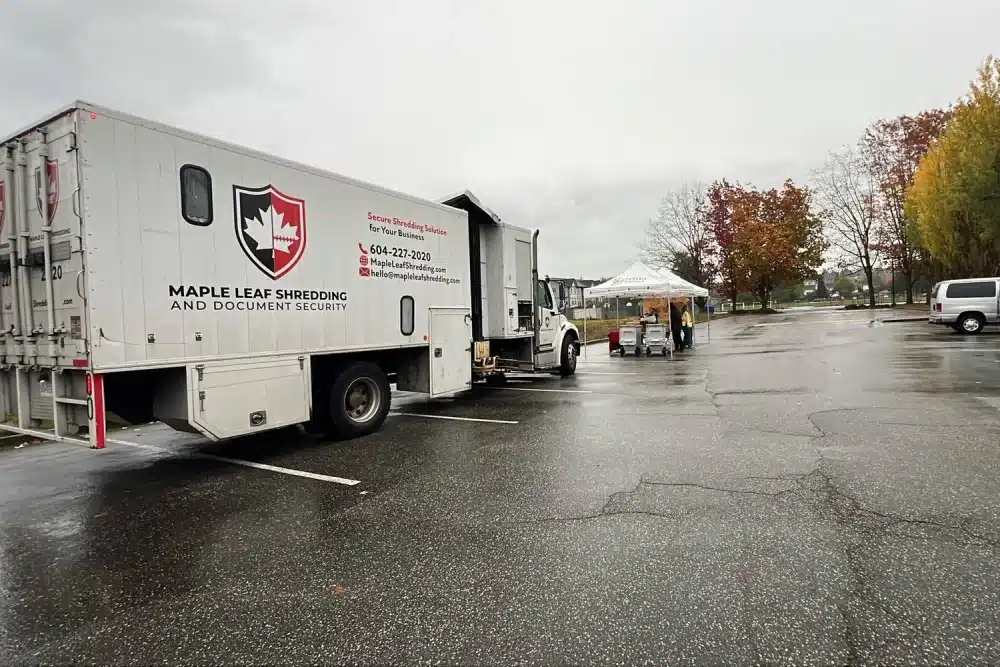
For many households and small businesses, the simplest option is to have the shredding done where the papers are. With on-site shredding Vancouver, a mobile shredding truck comes to your location and the documents are cross-cut shredded on site, in front of you, so they never leave your premises unsecured. Maple Leaf Shredding issues a Certificate of Destruction after the service.
If the cleanout is a single event rather than a recurring need — an estate, a move, or a year-end purge of expired tax years — a one-time shredding service fits better than a schedule. Gather the expired years, remove anything that must be kept longer, and book the purge as one job. For a household, residential shredding covers the same clear-out once each item has passed its date.
Old Hard Drives and Electronic Copies
Paper is only half of a retention cleanout. Old computers, drives and USB sticks often hold the same tax returns and payroll files as the paper boxes, and deleting a file does not erase it: formatting a drive does not make its data unrecoverable either. If you are looking for HDD Destruction Services near me, choose physical destruction for drives that held tax, payroll or client information.
Before you destroy a drive, check what is on it. A drive from a home office may hold the only copy of a return, a set of scanned receipts, or a backup of the current year. Copy anything still within its retention period to your current storage first, confirm the copy opens, and only then destroy the old drive.
A Simple Yearly Routine: Keep, Review, Shred
Retention is easier as a routine than as a project. Once a year, ideally in January, work through the oldest tax year now past its date. Check the box label against the six-year rule, confirm nothing in it is under objection or appeal, pull out any property or governing documents, and shred the rest. That is document retention in Canada as a habit, not a project.
Label every box when you file it, not when you clear it. Write the tax year and shred date outside — “2025 tax records — shred after December 31, 2031”. How long to keep mortgage documents is different again: keep them while the mortgage is active and after it ends, in a separate place from the tax boxes. Property deeds and wills do not belong with the tax year they arrived in, because they will outlive it by decades.
Frequently Asked Questions
- Do I count six years from the day I filed my return?
No, normally you count from the end of the tax year the records relate to. The exception is a late-filed return, where the six years run from the date you filed. A return for 2024, filed on time, is kept until the end of 2030.
- Can I scan my tax records and shred the paper originals?
Yes, if your imaging process meets the CRA’s electronic record-keeping conditions and the images are readable. Check the scans first, and log what was imaged and when.
- Do I need the CRA’s permission to shred records after six years?
No, After the period has ended, you need no permission for records kept under the Income Tax Act. You need written permission, through Form T137, only if you want to destroy them earlier.
Keep What You Must, Shred the Rest
Most confusion about how long to keep tax records in Canada comes from treating every paper as if it had the same life. It does not. Tax returns and the documents behind them live for six years from the end of the tax year. Everyday statements live for about a year, unless they support a claim. Property and governing documents live much longer.
When the expired pile is ready, Maple Leaf Shredding provides document shredding in Vancouver and the Lower Mainland — on-site shredding, one-time purges and hard drive destruction — with a Certificate of Destruction. Start with the oldest tax year, work forward, and keep the log.